YouTube niche pattern extraction: the research behind Vwrap's templates.
By the Vwrap team · Updated September 8, 2026
Niche pattern extraction is a research pass we ran over our own corpus, not a feature you run. A vision model read the thumbnails of 14,318 videos across 129 sub-niches, over-performers and normal performers side by side, and a significance test asked which thumbnail and title features separate the two. 34 of them produced a feature pattern that cleared the test. The other 95 did not. What reached the product is the template library in the create page's Template slot.
How an extracted pattern reaches your thumbnail
Open the Template slot
The create page carries four visual slots, and Template is the third of them. It holds one template at a time and opens a picker rather than a file dialog, because what goes in it comes from our library rather than off your disk. None of the four slots is required, and a run with the Template slot empty never touches any of this research.
Filter by niche, or search the blueprint text
Under the search box sit an All pill and fifteen niche pills, which are our 28 source parent topics folded into a coarser set for the picker. Search matches the archetype name, the niche and the blueprint description behind each card, so a query like "split-screen" finds the templates whose blueprint describes one even when their archetype name does not. The grid flattens templates against their variants, so every card is its own selectable option.
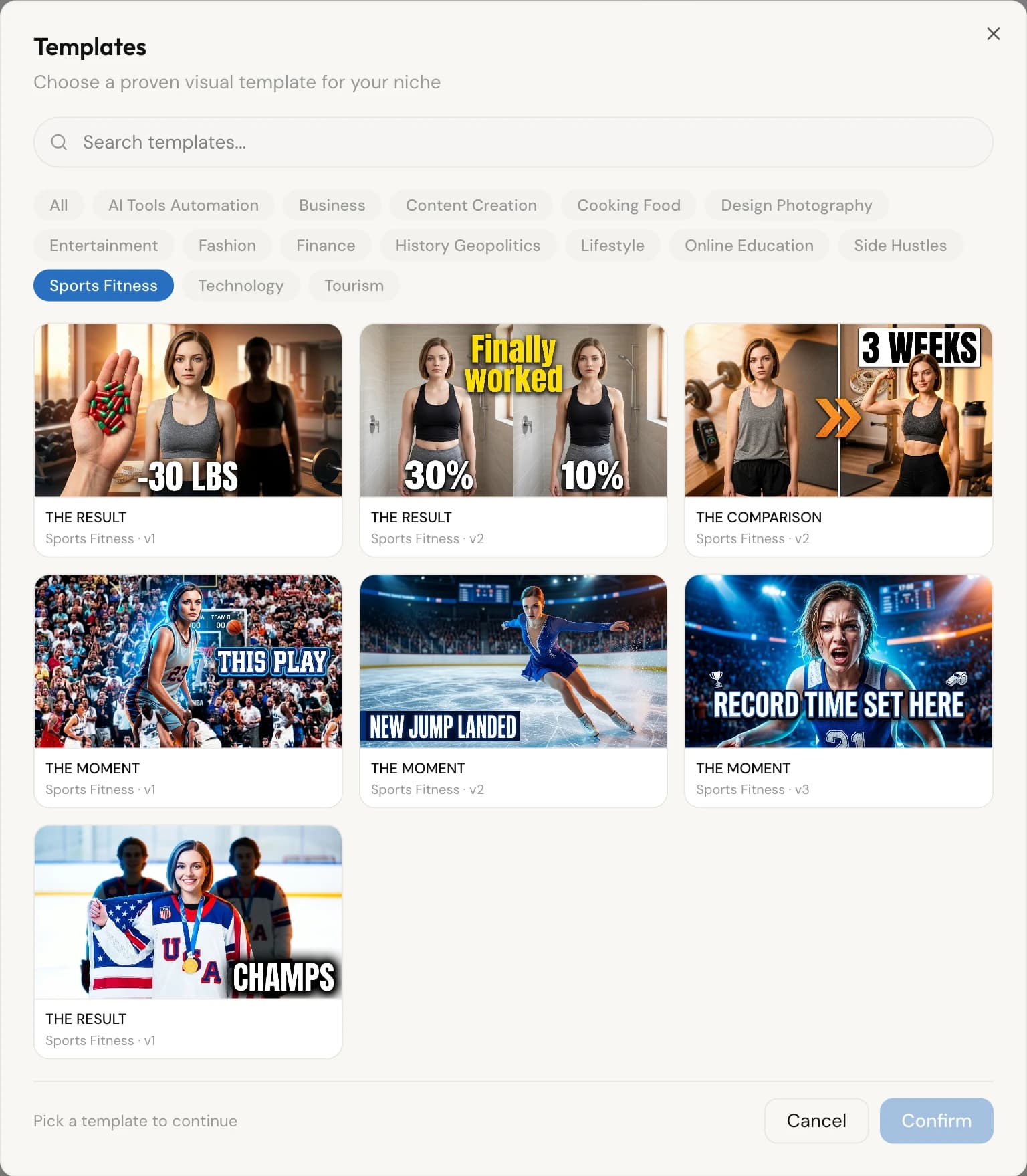
The picker filtered to Sports Fitness, holding seven approved variant cards. Each footer bar names the archetype the pattern belongs to, the niche, and which variant of it you are looking at. Pick a variant and confirm
Variants of one archetype are separate cards, so THE MOMENT v1 and THE MOMENT v3 are two different picks rather than two views of the same one. Confirming sends the template id and the variant index with your job. The slot then shows the preview you chose, and the remove control on it takes the template back out of the run.
Generate, and watch what the template contributes
The template's priors reach the planning pass every time: its archetype, its visual DNA, what the overlay text is for, and the blueprint sentence describing the pattern. With no reference image attached, the pixel-level constraints go through as well and the preview becomes the visual anchor the image model works from. Attach a reference and the constraints are dropped, because a reference you chose outranks a pattern we mined.
How a sub-niche gets screened
Before anything is extracted, a sub-niche has to earn its sample. The taxonomy holds 206 sub-niches under 28 parent topics, each carrying seed phrases written as though they were video titles, because the embedding model and Postgres full-text search were both trained on title-shaped text and underperform on topic descriptions. Every seed runs twice, once as a semantic search and once as full text, the two result sets merge by video id, and only long-form videos whose baseline confidence is MEDIUM or HIGH survive the filter.
What survives is then split in two. Outliers are videos at 2× their own channel's baseline or better; controls sit between 0.8× and 1.2×, meaning they did roughly what that channel normally does. A sub-niche clears the screen when it has at least 30 of each, and the last full pass, in May 2026, put 179 sub-niches through that test and let 129 through.
What the extraction pass reads
Each sampled thumbnail goes to a vision model under a locked schema, and what comes back is structure rather than description: composition and layout, whether a face is present and how much of the frame it fills, eye contact, gesture, the overlay text with its position and contrast, dominant and accent colour, a squint test for whether the subject still reads at small size, and how the thumbnail and the title divide the work between them. Title features such as word count, brackets, numbers and superlatives are computed by regular expression, with no model call at all.
The run behind today's templates covered 129 sub-niches and 14,318 distinct videos. A video appearing in two sub-niches is read once for each, which is why the pass stored 16,289 records, at a 99.2% success rate. Adding videos later is cheap, since the job resumes by video id. Changing the schema is not, because it forces every video to be read again.
What makes a pattern shippable
A feature has to separate outliers from controls and survive a significance test doing it. Each value is scored on a two-by-two table of outliers against controls, by chi-square, or by Fisher's exact test where any cell holds fewer than five videos. Whatever clears that bar is then combined two and three features at a time and tested again. The number that falls out is an uplift: the share of that sub-niche's outliers carrying the combination, divided by the share of its controls carrying it.
A sub-niche is shippable when some feature combination reaches 2.0× uplift with p below 0.05, ignoring combinations built on the older archetype labels, which no longer line up. 34 of the 129 cleared it. Console reviews came out highest at 17.5×, stock analysis at 9.9×, gameplay at 9.4×, sports highlights at 7.4×. The other 95 produced nothing that strong. That is a finding about how many niches run on a repeatable thumbnail formula, not a gap in the run.
From a pattern to a template you can pick
Templates are built per parent topic rather than per sub-niche. An archetype qualifies for a parent once it covers a tenth of that parent's outlier thumbnails or has at least five of them, and there are ten archetypes in the whole scheme: THE RESULT, THE MYSTERY BOX, THE BIG STAT, THE COMPARISON, THE PROBLEM/FAILURE, THE MOMENT, THE REACTION SHOT, THE LISTICLE, THE AUTHORITY and THE PRODUCT HERO. Each template's constraints are aggregates over the outliers that matched it: booleans by majority, categoricals by mode, numeric ranges as the 25th to 75th percentile.
The last build produced 190 templates covering all 28 parents. 126 rest on a combination that cleared the test, 60 on a single strong feature, and 4 on frequency alone. Every one carries a blueprint sentence generated from its own constraints, along the lines of face-dominant at 25 to 35 percent of frame, a four to seven word overlay, rule-of-thirds composition. The picker lists only admin-approved variants, so what is live is a subset.
Thresholds behind the research, and plan access
| Outliers a sub-niche needs to clear the screen, and controls, counted separately | 30 videos |
| Publication window the screen searches, counted back from the run | 365 days |
| Semantic candidates pulled per seed phrase, before the merge and the quality filter | 2,000 candidates |
| Full-text candidates pulled per seed phrase, merged with the semantic list by video id | 500 candidates |
| Outlier thumbnails an archetype needs before it becomes a template for its parent topic | 5 thumbnails |
| Real outlier thumbnails stored on each template as evidence; none of them surfaced in the picker | 5 thumbnails |
| Times each check video is re-read, to confirm the model answers consistently before the full batch runs | 3 runs |
| Videos in that consistency check | 10 videos |
| Sampling seed, fixed so a re-run draws the same control sample rather than a flattering one | 42 |
| Free plan after the trial, results returned per niche search | 4 results |
| Pro trial on signup: full Pro access, no card required | 7 days |
| Trial credits granted at signup; unused ones expire when the trial ends | 500 credits |
| Free plan monthly grant, first issued when the trial ends | 125 credits |
| Starter monthly credits; templates cost nothing to pick, so credits go on the generation | 2,500 credits |
| Pro monthly credits, which also unlock the premium image models | 5,500 credits |
| Studio, monthly credits | 15,000 credits |
What this research does not give you
- You cannot run it. Extraction was an offline pass over our own corpus, with no endpoint, no button and no way to point it at a niche or a channel of your choosing. The template library is the whole of what reached the product.
- Most sub-niches produced no shippable pattern: 34 of 129 in the last analysis. Templates were built anyway where an archetype rests only on a single separating feature, or only on how often it turns up, and the picker does not distinguish either of those from one that cleared the test.
- Uplift compares a sub-niche's outliers against its own controls, never against views. A 9.9× combination appears 9.9 times as often among that sub-niche's over-performers as among its ordinary uploads. It is a description of what already happened there, not a forecast for your video.
- That division has a floor. A control rate under 1% is treated as 1%, so a feature almost absent from controls reports a capped uplift rather than an enormous one. Read the very high numbers as strong rather than as precise.
- The corpus behind every figure here is long-form, found through English seed phrases, at MEDIUM or HIGH baseline confidence, and published within a year of the screen. Shorts were excluded outright, and a pattern mined from one language's thumbnails need not carry into another.
- The picker shows an approved subset, promoted one variant at a time, so its contents move and a sub-niche in the taxonomy can have no template behind it at all.
- A card shows you the preview, the archetype name, the niche and the variant number. The stored reference thumbnails, the constraint set, the uplift figure and the blueprint sentence stay behind the API, so there is no evidence panel to read before you commit.
- Preview images are generated, not collected. Each is drawn from its template's own constraints with a matching outlier as reference, so it illustrates the pattern rather than showing you a real creator's thumbnail.
- A template applies only when you fill the Template slot. Nothing picks one for you, and no other part of a generation run reads this research.
- Attach a reference image alongside a template and the template gives ground: the pixel-level constraints are dropped, because a reference you chose is treated as authoritative, and only the abstract priors carry through.
- The analysis is a snapshot rather than a feed. It re-runs as a batch, so a pattern that emerged in your niche over the last few months is not in it yet.
- Picking a template costs no credits, but it lives inside the create page and the generation it feeds bills the model's price per output. After the 7-day trial a free account gets 2 niche searches a day, the top 4 results of each, and 2 outputs per run; paid plans raise the daily search cap rather than removing it.